Showing posts with label melbourne. Show all posts

Wednesday, June 15, 2011

Zara, Melbourne, Fast Fashion & Fashion Addiction

Zara opened in Melbourne on
the 15th of June 2011
With great anticipation, the Zara juggernaut launched their latest store in their quest for global retail domination. Situated on pedestrian-friendly Bourke St, next to traditional department stores Myer and David Jones, Zara has picked prime real estate for their Melbourne incarnation.

After several weeks of frenzied activity with tradies in hard-hats and high-vis vests pulling double shifts throughout the night, the store opened with less fanfare than its Sydney rival. That said, the rope barriers for the queues were in full force, bouncers on the door, and a team of lowly paid security guards prevented wayward shoppers from stepping in-front of passing trams while gawking at the freshly painted fittings.

In terms of retail and clothing, Zara is something of a maverick. In began in 1975 and has now grown into a global player with over 2000 stores in 77 countries. It's owner, Amancio Ortega, is now the 9th richest man in the world. Zara usually copies fashion trends and designs around the world, rather than creating its own.

Almost all global clothing chains, from high end to your Kmart garden variety, have outsourced the manufacturing of their product to cheaper labour factories in Asia. However Zara opts for European clothes manufacturing, where it owns the factories and distribution methods. The upshot of this situation is that Zara can quickly turn out new stock much faster than its rivals. It is said that Zara can design, model, create and distribute new product within a 3-4 week period, compared to the industry average of 6 months. Most outlets might produce 2,000 to 4,000 new pieces each year, whereas Zara produces in excess of 10,000. 
Security guards prevent wayward shoppers from
swelling onto the tram tracks

Fast Fashion
With considerable control over the supply chain and a frenzied approach to creating new product, Zara has pioneered the concept of fast fashion. This concept not only embodies the idea of quickly moving new creations from the catwalk to the store window, but also completely blasts the once normal concept of fashion seasons out of the water. Fast fashion thrives on the endlessly unquenchable desire for something new and requires constant change with new product to match. While traditional stores supply stock based on four seasons, Zara pumps out fresh stock twice a week, for a '104 seasons' a year cycle. 

The emphasis on fast fashion has a interesting effect on buying behaviour with customers. Normally, customers might visit a store a couple of times a year, whereas Zara sees repeat business in the order of 6 times greater than its rivals. It is reported that the customers return on average to Zara seventeen times in one year.

Crowds gather on the opening day, eager to dive into fast fashion

Fashion Addiction?
There is no denying that Zara are very savvy at what they do. They have not only created a successful business, but their business model is built upon the new and ever-changing. They have begun a sweeping change of the way customers view clothing, from seasonal, to twice-weekly. Constantly producing new designs and updating floor stock give the customer the impression that to keep up-to-date requires purchases on a weekly basis. This model though, encourages classic addictive behaviour. Clothing has moved beyond the realm of practicality and into the disposable, instant and one-time-use. While one can critique the fashion pros and cons of the situation, the implication is that clothing puts greater demand on the wallet. While we are encouraged to pursue the fashion-bleeding-edge, the Ortegas of this world smile all the way to the bank.

-------------
Further Information

For a concise overview of Zara, check out this Hungry Beast video: http://hungrybeast.abc.net.au/stories/beast-file-zara


Saturday, April 23, 2011

The Way of the Cross, Melbourne 2011

The Way of the Cross stops
outside St Patrick's Cathedral
Yesterday we had the pleasure of joining the Way of the Cross service in Melbourne as part of the Easter celebrations put on by the city churches. I had heard about the service in the past, but this was the first time that I was in the neighborhood and I thought it might be interesting to check out.

It is billed as an ecumenical devotion and it begins at St Francis' church on Lonsdale St while ending at St Paul's Cathedral on Flinders St. Along the way, the route weaves between significant CBD churches with each stopping point marking Christ's key moments from the last supper until his death on the cross. These moments have traditionally been called the stations of the cross and within Melbourne, these stations are marked by a series of 15 permanent sculptures, each residing in the grounds of the various urban churches.

One of the sculptures that mark
the stations of the cross
After hurriedly racing through the city, I managed to catch up with the progression out the front of St Patrick's Cathedral. Several impressions were immediately apparent. Firstly, the crowd of people attending the service was quite sizeable. I estimate about a thousand, but Channel 9 news who were covering the Easter march, reported hundreds. The demographics of the crowd was an interesting mix of nationalities and cultural backgrounds, with most age brackets represented, except for the youth/uni category who presumably are naturally under-represented in urban churches anyway.

Secondly, the organisers had rigged up a portable PA system which allowed the priests and ministers to pass around a wireless mic while two vans had four-way loudspeakers respectfully broadcasting the service to the outer-reaches of the throng. Usually one van would be slightly behind the crowd, while the other acted as the vanguard to the mobile service. The march had a police escort, consisting of several uniforms who walked the outer fringe and a couple of cop cars who blocked off the streets. At some moments, it felt like I should have been holding a placard and chanting some catchy three word sentence - particularly when the route passed Parliament by.

The organisers had a portable PA system to broadcast the service to the crowd
Ballieu had no need to be worried though. The service was equal parts funeral procession and proud proclamation, more reverent than demonstrative. Curious onlookers - once they saw the wooden cross and put-two-and-two together about the reason for their relaxing day off - didn't quite know how to handle such an obvious display of Christianness. Thankfully, no-one loudly vented their issues with the church or make offensive gestures, with most opting for a good old-fashioned gawk or shuffling of their shoes. The only real disturbance was the MFB who raced by and drowned out a poor minister in the middle of a prayer with sirens blaring.

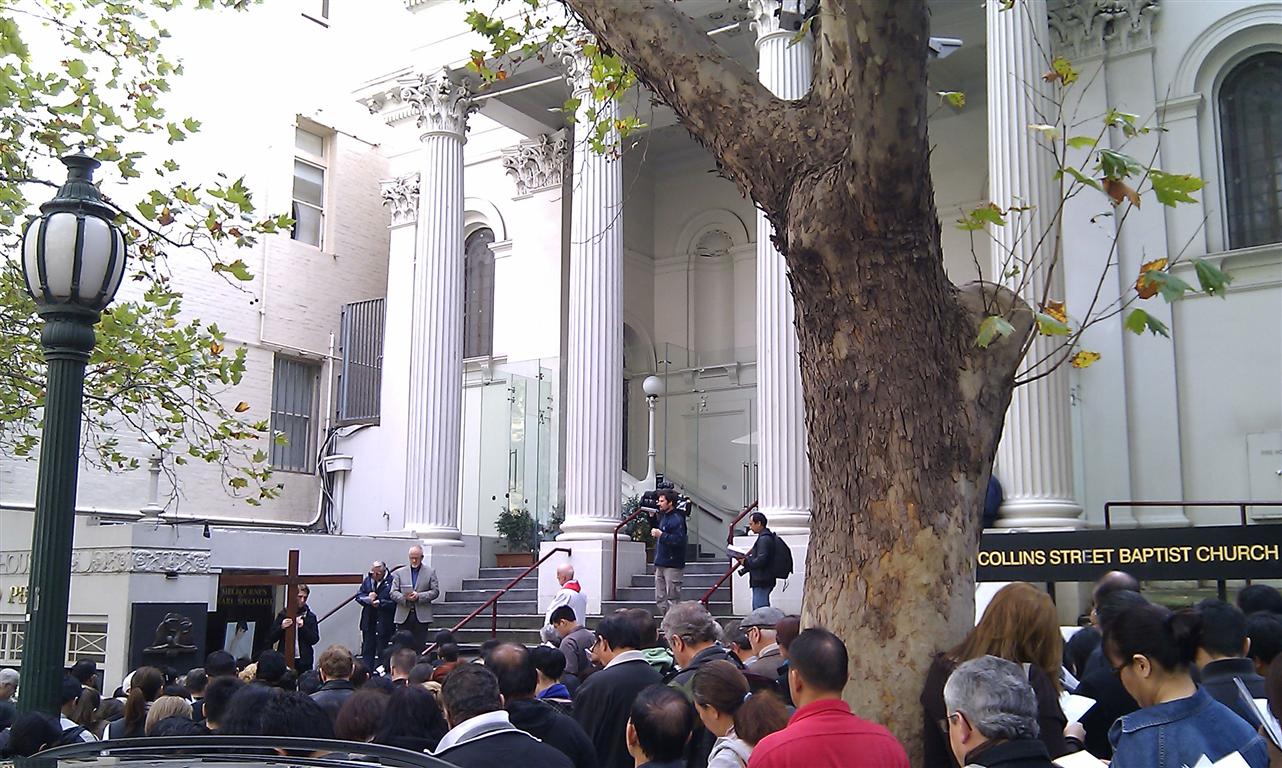
Station 11: Collins Street Baptist Church
We followed a large wooden cross that acted as a heraldic standard for the walking mass. The holder of the cross changed hands at every station with seemingly random people chosen from the crowd, perhaps reflecting the way the ancient Romans selected individuals from the side-lines to help the condemned carry the cross. At each station, a mini service was held, which followed a strict liturgy that was neatly documented in a professional booklet that was freely available. These services included a brief catechism, bible reading, reflection on the bible reading in the form of a poem, common prayers, call-and-response prayers, and a hymn to finish off with.

Station 12: St Paul's Cathedral
Swanston St entrance
Generally everything was fairly straight-down-the-line theologically speaking, although the call-and-response prayers were heavily focused on social justice issues such as depression, homelessness, gender equality, prisoners, pimps, druggies, gangs, the abolition of the death penalty, terminally ill patients and funeral companies. While I agree that these concerns should be matters that the church should consider, I'm not convinced that Good Friday is the best time to address them. Conversely, their inclusion did demonstrate the relevance of the gospel to 21st century Australia.

As the service concluded on the steps of St Paul's and students from Melbourne Grammar handed out juice boxes and hot cross buns (donated by Brumby's bakeries), it was apparent that this was a very special Christian event to have participated in. It was fantastic to see such unity between the different denominations (Catholic, Anglican, Lutheran, Baptist, Uniting, Church of Christ, etc) and to actually visit the steps of so many majestic places of worship. Melbourne truly is a great city and it was an honour to be part of the moving congregation, rubbing shoulders with random believers from different perspectives, and reflecting upon Christ's awesome sacrifice outdoors with the wind in your hair, sun on your face and trams reverberating past.